


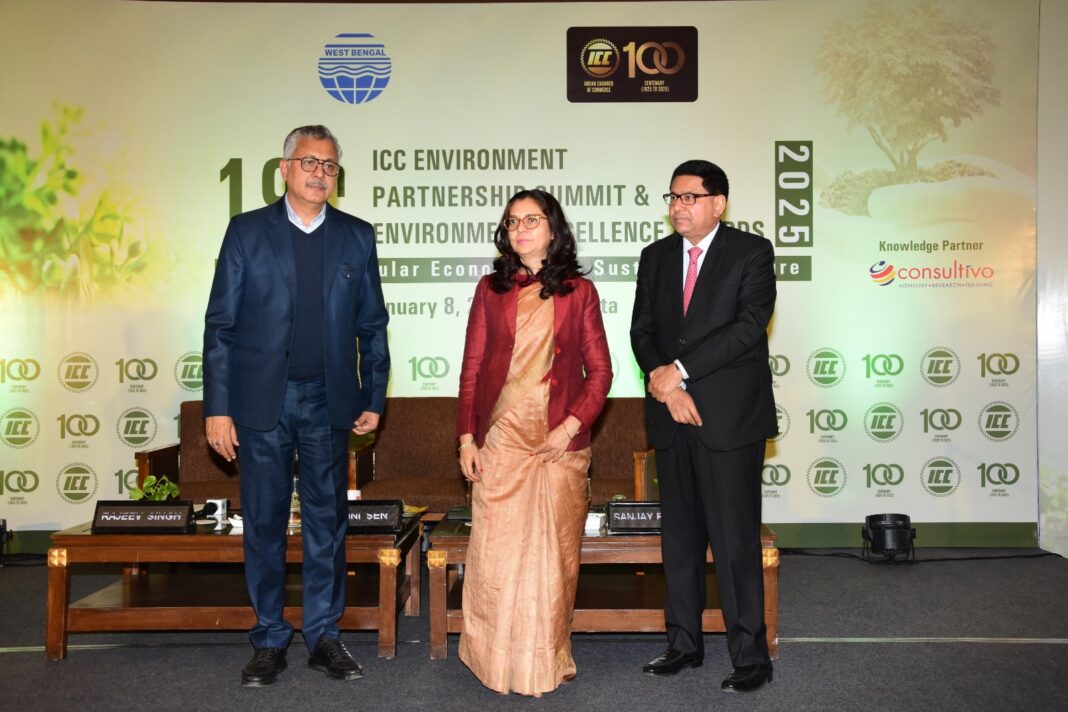
The West Bengal government is intensifying efforts to convert waste into economic value as part of a broader push towards a circular economy, State Additional Chief Secretary (Environment) Roshni Sen said while addressing the 19th Indian Chamber of Commerce (ICC) Environment Partnership Summit & Environment Excellence Awards in Kolkata.
Sen said the state has initiated multiple waste-to-wealth programmes, including the conversion of rural slaughterhouse waste into organic fertiliser, now being used for crop cultivation such as potatoes and other vegetables.
She said the mechanism, developed by the Department of Science, Technology and Biotechnology, has already been patented, underscoring the government’s focus on innovation-driven sustainability.
Describing the summit theme as “both apt and timely,” Sen called the circular economy “one of the most neglected yet critical global challenges,” driven by rapid population growth, escalating waste generation and growing pressure on finite natural resources.
“Moving away from the linear ‘take-make-dispose’ model is no longer optional. The focus must be on reduction, reuse, recycling and recovery,” she said, adding that extending product life cycles and reintegrating materials into production systems are key priorities.
Highlighting infrastructure initiatives, Sen pointed to a 500-tonne-per-day construction and demolition waste facility at Pathuriaghata, urging developers to maximise its utilisation. She also said a state-of-the-art e-waste recycling facility is nearing completion at Sonarpur Hardware Park, with WEIDEL designated as the state’s implementing and nodal agency for e-waste management.
A Special Purpose Vehicle has been formed by the MSME and Textiles Department for coordinated waste management, while recyclers and re-traders have been recognised as a distinct industrial category through the Shilpa Sathi single-window system, she said.
Emphasising Extended Producer Responsibility (EPR), Sen noted that 100 per cent registration has been achieved for producers, importers, brand owners and recyclers under plastic, battery and e-waste portals. “More than 1.18 lakh kg of e-waste was recycled in 2024–25, and current-year figures are expected to cross one lakh kg,” she added.
Speaking at the summit, ICC Past President and Patton Managing Director Sanjay Budhia said that in a world of finite resources, embracing circular economy principles is essential. He noted that full adoption could yield annual benefits of nearly ₹40 lakh crore by 2050 and highlighted West Bengal’s initiatives to establish waste processing plants across 128 municipalities by 2026 and convert the Dhapa landfill into a waste-to-energy hub.
Dr Rajeev Singh, Director General, ICC, underlined the role of industry in driving sustainable transformation. “By recognising champions through the Environment Excellence Awards, we inspire others and spread the spirit of change,” he said, congratulating award winners for their commitment to sustainability.
From a financial and development perspective, P.K. Bhardwaj, Chief General Manager, NABARD, said the circular economy is a global imperative and not merely a waste-management strategy. He noted that by 2050, circular systems could generate over US$2 trillion in economic value and create nearly 10 million jobs worldwide, while NABARD’s Climate Strategy 2030 aims to scale green lending and climate-resilient livelihoods.
Saikat Basu, CEO of Consultivo, said the transition to circularity has become a present-day strategic necessity for businesses. Pointing out that globally only 6–8 per cent of materials are cycled back into the economy, he stressed that true circularity begins at the design stage, with products created for repair, reuse and disassembly.
Prof. (Dr) K.M. Agarwal, Director, IISWBM, said the circular economy is now an industrial necessity, noting that less than 10 per cent of resources are recycled annually. He highlighted that industrial symbiosis, including the use of fly ash and slag in cement, makes circular practices commercially viable while ensuring long-term resource security.
Prof. (Dr) Anirban Gupta of IIEST Shibpur said hyper-consumerism driven by planned obsolescence is incompatible with sustainability. He called for a fundamental shift in product design and business models towards durability, serviceability and responsible consumption.
Aloke Mookherjea, Chairman of the Jury Board, ICC Environment Excellence Awards, said sustainability and circularity are no longer a choice. “Growth in a circular economy is measured not by what we consume, but by what we preserve,” he said.
The summit brought together policymakers, industry leaders, financial institutions and academics, all calling for faster, coordinated action to transition towards a circular economy that balances environmental protection with economic growth.

 Roshni Sen said while addressing the 19th Indian Chamber of Commerce (ICC) Environment Partnership Summit & Environment Excellence Awards in Kolkata.)