


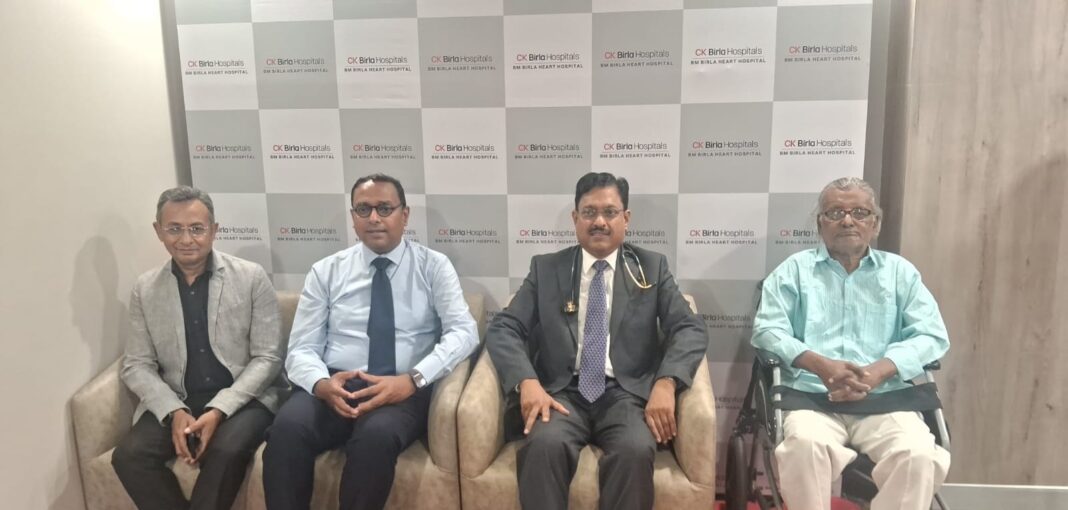
CK Birla Hospitals, BM Birla Heart Hospital has successfully carried out the world’s first documented extraction of a leadless pacemaker implanted for over seven years, followed by implantation of a new-generation Aveir VR leadless pacemaker. The device, originally implanted in 2018, was safely retrieved by Dr. Anil Mishra, Director of Cardiology, marking a path-breaking global milestone in advanced cardiac electrophysiology. This achievement also represents the first such case in South East Asia, including India, and reinforces BM Birla Heart Hospital’s leadership in managing highly complex cardiac device procedures
The elderly patient had a long and complex cardiac history. After undergoing coronary interventions and bypass surgery in earlier years, he required pacemaker support for symptomatic bradyarrhythmia. A conventional system implanted in 2018 had to be removed due to recurrent infection. During the same admission, a leadless pacemaker was positioned in the low right ventricular septum. The device functioned reliably for several years.
In January 2026, the pacemaker reached its Elective Replacement Indicator (ERI), signalling battery depletion and the need for renewed pacing support. Retrieval of leadless pacemakers shortly after implantation has been reported in isolated instances. Retrieval after prolonged implantation, however, is a different matter. Over time, the device becomes embedded within fibrotic tissue and endothelialised along the ventricular wall. After years in situ, separation from the myocardium carries real procedural risk — including perforation or embolisation.
Across Southeast Asia, reported retrievals have typically involved devices implanted for few days to two to four years. In India, there has been no prior documentation of successful extraction beyond the early 1 week post-implant period. In this case, the device had remained implanted for over seven years.
Dr. Mishra and his team had to decide whether to leave the depleted device in place and implant an additional leadless pacemaker — an approach sometimes adopted — or attempt removal. Long-term data on multiple leadless devices within the right ventricle remains limited, and concerns regarding mechanical interaction or interference influenced the decision.
After careful assessment, the team proceeded with retrieval under temporary pacing support via the left subclavian route. The device was extracted in a single attempt without complication. A new single-chamber VVIR leadless pacemaker was then implanted in the low right ventricular septal region with stable thresholds and excellent electrical parameters. The patient has recovered well, with post-procedure imaging confirming satisfactory positioning and function.
Reflecting on the case, Dr. Anil Mishra, Director of Cardiology, BM Birla Heart Hospital, said, “Leadless pacemakers were designed to reduce many of the complications associated with transvenous systems, but their long-term management is still evolving. When a device has been in place for several years,
fibrotic encapsulation makes retrieval uncertain and technically demanding. The key is preparation — understanding the degree of fixation, planning for potential complications, and ensuring pacing backup at every stage.
In this instance, the patient’s co-morbidities and frailty made it important to avoid leaving multiple intracardiac devices unless absolutely necessary. The procedure required controlled traction, precise catheter manipulation, and continuous haemodynamic monitoring. Cases like this underline the importance of experience in device management. They are not routine interventions, and they demand a coordinated team.”
BM Birla Heart Hospital has developed a dedicated electrophysiology and device management programme capable of handling complex rhythm disorders, advanced device implantation, and extraction procedures. The successful retrieval of a long-standing leadless pacemaker adds to the hospital’s growing body of high-complexity cardiac rhythm interventions.

