

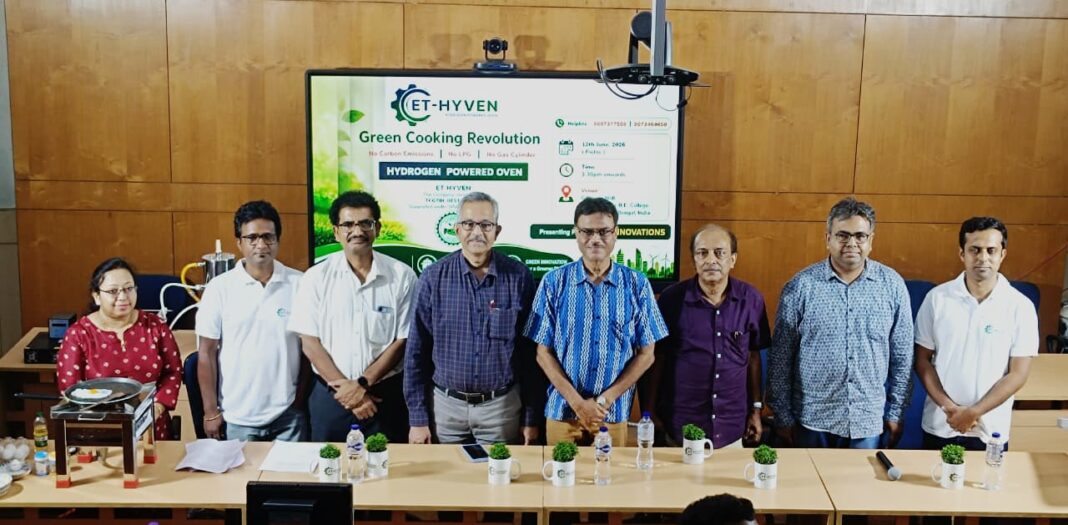
In a landmark breakthrough that could redefine the future of clean cooking and decentralized energy usage in India, the Indian Institute of Engineering Science and Technology (IIEST), Shibpur, will unveil a first-of-its-kind indigenous Green Hydrogen Cooking Oven capable of generating hydrogen on demand without the need for storage cylinders.
The pioneering innovation, developed under the institute’s technology incubation ecosystem, represents a significant advancement in India’s efforts towards energy transition, carbon reduction and self-reliance in clean fuel technologies. The system has been specifically designed to address one of the most critical challenges in hydrogen adoption — safe storage and transportation — by producing hydrogen instantly through water electrolysis and consuming it immediately for cooking applications.
The technology is expected to open new possibilities for commercial kitchens, institutional food services, restaurants, hotels, cloud kitchens, community feeding centres and large-scale government food programs across the country.
Addressing India’s Energy Challenge Through Innovation
India currently imports a significant portion of its energy requirements, including LPG and other fossil-fuel-based resources. With rising energy demand, fluctuating global fuel prices and increasing climate commitments, the need for alternative clean energy solutions has become more urgent than ever.
Globally, nations are rapidly investing in hydrogen as a cornerstone of the future energy economy. While hydrogen applications have largely focused on mobility, heavy industry and power generation, practical deployment in cooking applications has remained limited due to safety and infrastructure challenges.
The Green Hydrogen Cooking Oven developed at IIEST Shibpur addresses these barriers by creating a safe, compact and scalable solution capable of generating hydrogen precisely when needed, eliminating the requirement for storage cylinders altogether.
A Potential Game-Changer for Bengal’s Mid-Day Meal Ecosystem
West Bengal operates one of the country’s largest school feeding ecosystems, serving millions of students through government-supported Mid-Day Meal programs every day. A substantial portion of operational expenditure in these kitchens is linked to cooking fuel costs.
The newly developed hydrogen-powered cooking technology has the potential to offer a sustainable and economically viable alternative for centralized and decentralized community kitchens. When integrated with solar power systems, the solution can significantly reduce dependence on LPG and other conventional fuels while lowering operating expenses over the long term.
Experts believe such innovations could eventually support cleaner, more affordable and energy-secure cooking operations for schools, hostels, social welfare institutions and public feeding programs across the state and beyond.
Advancing India’s Net-Zero and Green Hydrogen Mission
The innovation aligns closely with the Government of India’s National Green Hydrogen Mission and the country’s commitment to achieving Net-Zero emissions.
Key benefits include:
- On-demand generation of green hydrogen without storage cylinders
- Zero carbon emissions at the point of use
- Compatibility with solar and renewable energy systems
- Reduced dependence on imported fossil fuels
- Enhanced energy security through decentralized fuel generation
- Potential large-scale commercial and institutional deployment
By expanding hydrogen applications into everyday commercial energy consumption, the technology demonstrates how green hydrogen can move beyond industrial sectors and become part of mainstream economic activity.
Robust Safety Architecture
Recognizing public concerns around hydrogen safety, the developers have incorporated multiple layers of protection including: - Advanced leak detection systems
- Automatic shutdown mechanisms
- Continuous flame monitoring
- Pressure regulation controls
- Emergency response protocols
The integrated safety architecture is designed specifically for commercial operating environments where reliability and operational continuity are critical.
Commercial Potential and Future Roadmap
The technology is expected to have significant market potential across: - Hotels and hospitality establishments
- Restaurants and food courts
- Cloud kitchens
- Institutional kitchens
- Educational campuses
- Industrial canteens
- Food processing facilities
- Government and community feeding centers
The development team plans to undertake pilot deployments, strategic industry partnerships and phased commercialization initiatives over the coming years. Successful scaling could position India among the global leaders in hydrogen-based cooking technologies and create a new category within the clean energy ecosystem.
Distinguished Dignitaries Present
- Prof. V. M. S. R. Murthy, Director, IIEST Shibpur
- Prof. Pratik Dutta, Dean – Research & Consultancy, IIEST Shibpur
- Prof. Manas Kumar Sanyal, Secretary, TCGTBI & Head, Department of Human Resource Management
- Prof. Konika Das (Bhattacharya), Professor, Department of Electrical Engineering & Chairperson, Industry Institute Partnership Cell
- Prof. Sudip Kumar Roy, Professor, Department of Civil Engineering & Member, TCGTBI
- Dr. Jnui Deb Mallick Datta, Faculty Coordinator, TCGTBI
The unveiling marks a significant milestone in India’s clean energy innovation journey and showcases how indigenous research and technology development can contribute meaningfully to sustainable economic growth, environmental stewardship and national energy security.

