

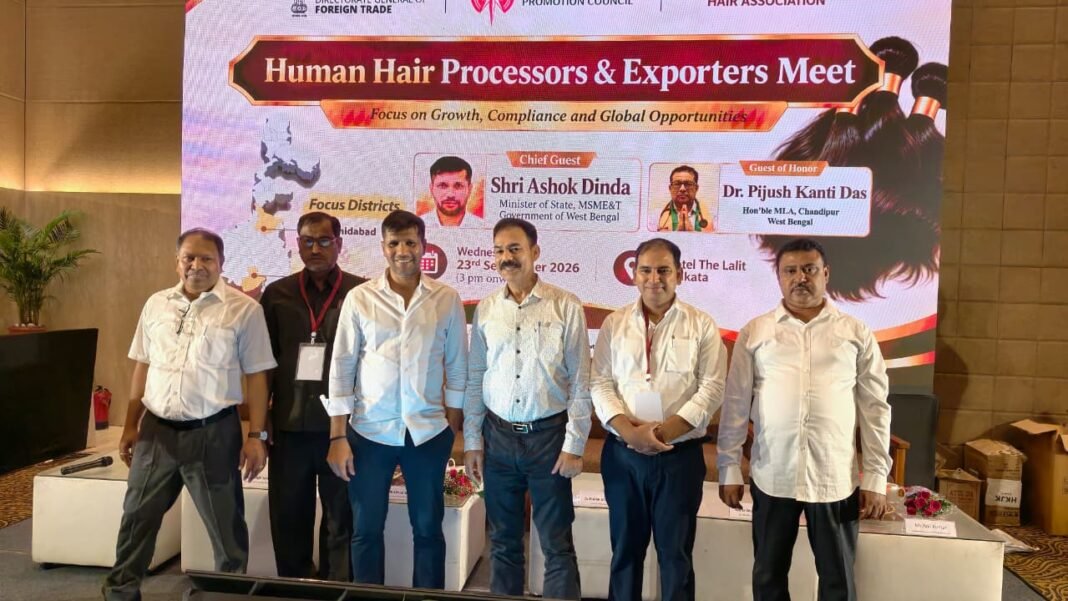
The Human Hair Processors & Exporters Meet brought together government officials, industry representatives and stakeholders to address the growing challenges faced by West Bengal’s human hair processing and export sector, particularly in East Midnapore and Murshidabad.
The meet was attended by Shri Ashok Dinda, Minister of State, MSME&T, Government of West Bengal; Dr. Pijush Kanti Das, MLA, Chandipur; Mr. Anil Kumar, Assistant Commissioner of Customs (Kolkata Air Cargo); Mr. SK Mukul Ali, COA Member, PLEXCONCIL; and Mr. Manoj Samanta, Secretary, West Bengal Human Hair Association.
The discussions highlighted the sharp rise in raw human hair prices, shrinking margins for processors and the need to strengthen domestic value addition. Industry representatives noted that India’s human hair exports had reached approximately USD 943 million in FY 2025-26, while thousands of workers, particularly women, remained dependent on the sector for their livelihoods.
Speaking on the occassion Mr. Manoj Samanta, Secretary, West bengal Human Hair Association said “West Bengal’s human hair industry has enormous potential to become a stronger value-added manufacturing sector. For years, a significant portion of raw hair has been exported, while the major value addition and profits have been generated outside the state. We welcome the government’s focus on developing modern processing facilities and clusters within West Bengal. With better infrastructure, advanced machinery and institutional support, we can create more employment, improve the earnings of grassroots workers and establish ‘Made in India’ human hair products in global markets.”
Shri. Ashok Dinda, Minister of State, MSME&T, Government of West Bengal said “West Bengal’s multi-thousand-crore human hair industry supports over 25 lakh workers, particularly women. The state government is now shifting from raw hair exports to local value-added production by developing modern processing facilities and industrial clusters. Through the MSME Department, entrepreneurs and grassroots workers will receive infrastructure, advanced machinery and a secure business environment, helping increase local profitability and ensure better earnings for artisans.”
The meet also focused on the need to regulate raw hair exports, strengthen monitoring mechanisms against illegal movement and encourage the manufacturing of value-added products such as wigs, hair extensions and other processed hair products within India.
Participants called for greater government support for skill development, technological modernisation, mechanisation and dedicated processing infrastructure, including appropriate environmental management systems.
The stakeholders also emphasised the importance of protecting women’s livelihoods while promoting ethical and sustainable practices across the sector. The meeting concluded with a call for coordinated policy intervention to safeguard domestic processors, strengthen MSMEs and transform West Bengal into a major hub for value-added human hair products under the “Made in India” initiative.

