

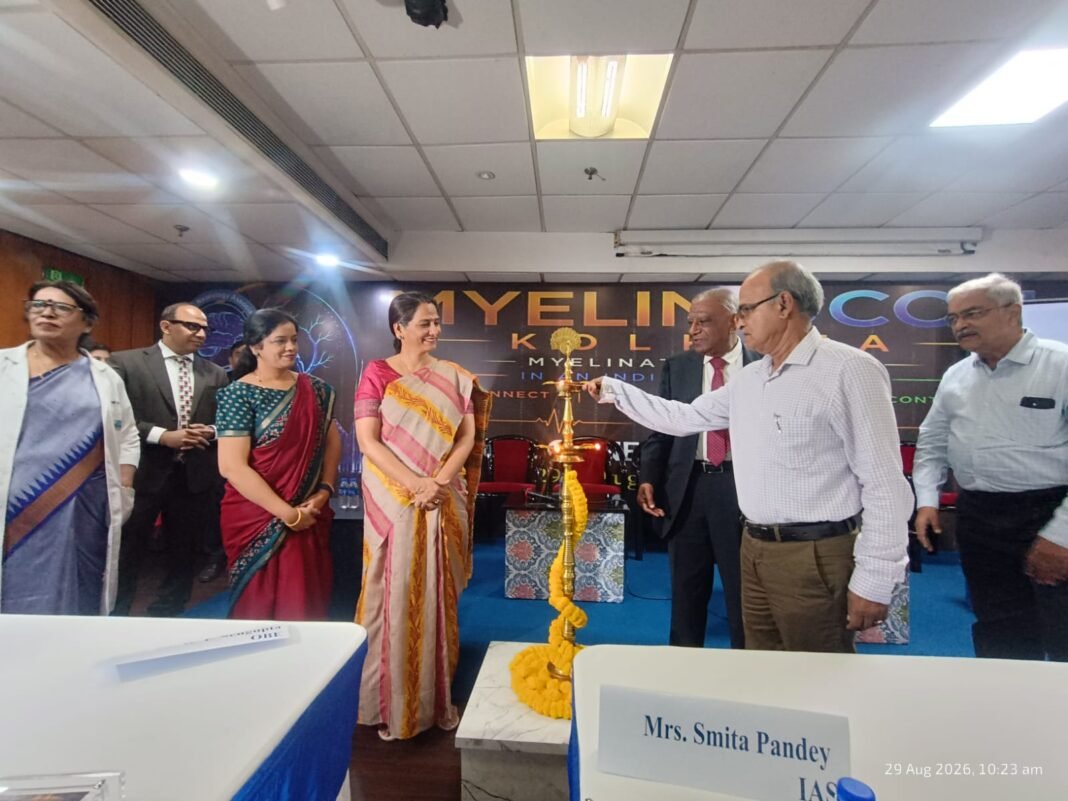
The Institute of Neurosciences Kolkata (INK) is set to host the first MYELINOCON Kolkata – Myelinated Updates in an Indian Perspective, a focused scientific meeting bringing together leading neurologists, neuroimmunologists, ophthalmologists and specialists in demyelinating diseases from across India.
The conference will be held on 29 August 2026 at the 9th Floor Seminar Hall, Institute of Neurosciences Kolkata and is CME accredited with 5 WBMC credit points.
Unlike conventional academic meetings that often focus predominantly on reviewing published evidence, MYELINOCON has been designed around a more practical question:
How does the rapidly changing science of demyelinating disease actually translate into decisions at the bedside in India?
The programme moves from new diagnostic criteria and diagnostic dilemmas to seronegative disease, disease biology, emerging imaging biomarkers, immunotherapeutics and special populations, providing clinicians with a structured approach to contemporary CNS demyelinating disorders.
The meeting will begin with contemporary approaches to diagnosis, including the 2024 McDonald criteria for multiple sclerosis, followed by updates in NMOSD and the 2023 MOGAD criteria. Particular emphasis will be placed on translating these evolving diagnostic frameworks into real-world Indian clinical practice.
A dedicated session will address one of the most difficult problems faced by clinicians—the seronegative patient—including seronegative optic neuritis, transverse myelitis and cerebral demyelination that does not fit neatly into MS, NMOSD or MOGAD.
The conference will then move beyond conventional diagnostic thinking into the biology of disease progression.
One of the central scientific discussions will be “The Pathogenesis of PIRA in Multiple Sclerosis: Can We Identify and Target the Silent Progression?”, exploring how disability can accumulate independently of obvious relapses and how emerging biomarkers may help identify this process earlier.
A new era of biomarkers and imaging
Another major focus will be the expanding role of advanced imaging and ophthalmic biomarkers in demyelinating disease.
The programme will examine how the eye can act as a window to demyelination, alongside emerging MRI biomarkers that may provide information beyond conventional assessment of new T2 or gadolinium-enhancing lesions.
The scientific discussions are designed to connect these emerging concepts with clinical practice—particularly the increasingly important question of how clinicians can detect ongoing disease biology even when conventional measures appear relatively stable.
Moving beyond conventional immunotherapy
The immunotherapeutic session will bring together some of the most important contemporary treatment questions in MS and related disorders.
Topics include B-cell therapies in MS and NMOSD, immune reconstitution therapy in MS, biologics in NMOSD and B-cell therapies in steroid-dependent MOGAD. The emphasis will be on choosing treatments according to efficacy, safety, patient characteristics and the realities of treatment in India.
The meeting will also address practical issues that increasingly influence long-term treatment decisions, including infection risk, vaccination, pregnancy, paediatric demyelinating disease and medical ethics.
Prof R P Sengupta OBE, Chief Patron, MYELINOCON, Said:
“I am delighted that the Institute of Neurosciences Kolkata is organizing Myelinocon 26 with the theme of Myelinated Updates in Indian perspective. We know that the profile of Indian patients is different than those in the western countries. Therefore, exchange of ideas amongst the leading neurologists of India will lead to a better understanding for the benefit of our patients.”
Dr Pritam Majumdar, Organizing Secretary, MYELINOCON, said:
“Demyelinating diseases are changing rapidly. We are no longer dealing with the MS of a decade ago, and our understanding of NMOSD and MOGAD is evolving just as quickly. MYELINOCON was conceived with a simple objective—to move beyond simply presenting studies and instead ask what these advances actually mean for the patient sitting in front of us.”
“We have deliberately built the programme around the problems clinicians encounter every day—diagnostic uncertainty, seronegative disease, silent progression, new imaging biomarkers and the rapidly expanding therapeutic landscape. Most importantly, we want to discuss these advances through an Indian lens, where access, affordability, monitoring and treatment realities can be very different from those described in Western trials.”
Prof. Hrishikesh Kumar, Organizing Chairman, MYELINOCON, said:
“Neurology is entering an exciting phase where our understanding of demyelinating disease is becoming increasingly precise. We are beginning to recognize that controlling relapses is only one part of the challenge. The next frontier is understanding what happens between relapses and how ongoing biological processes contribute to disability.”
“MYELINOCON brings together experts across different areas of demyelinating disease to create a forum where these developments can be discussed not only from a scientific perspective, but also from the perspective of what they mean for everyday patient care.”
Dr Ashis Dutta, Organizing Chairman, MYELINOCON, said:
“The idea behind MYELINOCON is to create a meeting that is intellectually rigorous but clinically grounded. The field of demyelinating disease is expanding at an extraordinary pace, and clinicians need a forum where new diagnostic concepts, biomarkers and therapies can be critically examined rather than simply accepted.”
“We hope MYELINOCON will become a platform for meaningful scientific exchange, collaboration and continued learning in demyelinating diseases, with a particular emphasis on what can realistically be implemented in the Indian healthcare setting.”

